
Consciousness - Part III
From Greek Mythology to Modern Neuroscience

The Ship of Theseus
Here’s an old puzzle. Theseus, the hero of Greek myth, owns a famous ship. Over the years, every plank rots and is swapped out for a new one. When the last original plank is gone — is it still the same ship? Now imagine someone saved each old plank and built a second ship from them. Two ships. Which one is really Theseus’s?
There’s no clean answer. The puzzle reveals something unsettling: identity, the thing that makes an object the same object over time, is not a fixed fact about the world. It’s a story we agree to tell.
Now try the same thought experiment with a brain. Imagine a surgeon, neuron by neuron, replaces every cell in your brain with an artificial one — perfectly identical in function, same connections, same firing patterns. You stay awake throughout. You keep talking, remembering, feeling. When the last neuron is swapped, who is in the chair?
Depending on your philosophy, the answers diverge dramatically. A functionalist says: you. Completely you. The pattern survived, and the pattern is all that matters. It doesn’t matter whether the neurons are carbon or silicon — consciousness rides the structure, not the substance. Reassuring, until you realise that if someone also reassembled all the original neurons, two people would exist with an equal claim to being you. The theory offers no way to choose.
A biological naturalist — someone who thinks consciousness is specifically a product of living tissue — might say something was quietly lost with each replacement, so gradually it was never noticed. The new brain behaves identically. It reports feelings. It passes every test. But maybe there’s no one home. This is deeply uncomfortable. It means you could build a perfect human imitation and never know it wasn’t conscious.
A panpsychist gives the strangest answer: nothing was lost, but nothing was quite preserved either. Each new artificial neuron brings its own tiny grain of experience. The replacement brain is conscious — but differently so, like a song played on a different instrument.
Both puzzles — the ship and the brain — circle the same drain. We want identity to be a fact, a thing with sharp edges. But it keeps dissolving into questions of what we value and what we mean. The hard problem doesn’t just ask what consciousness is. It asks what you are.
This week we’ve explored all possibilities, understood Philosophy of Mind as things stand today.
What about you? What resonates most with you, and why? What are we missing here?
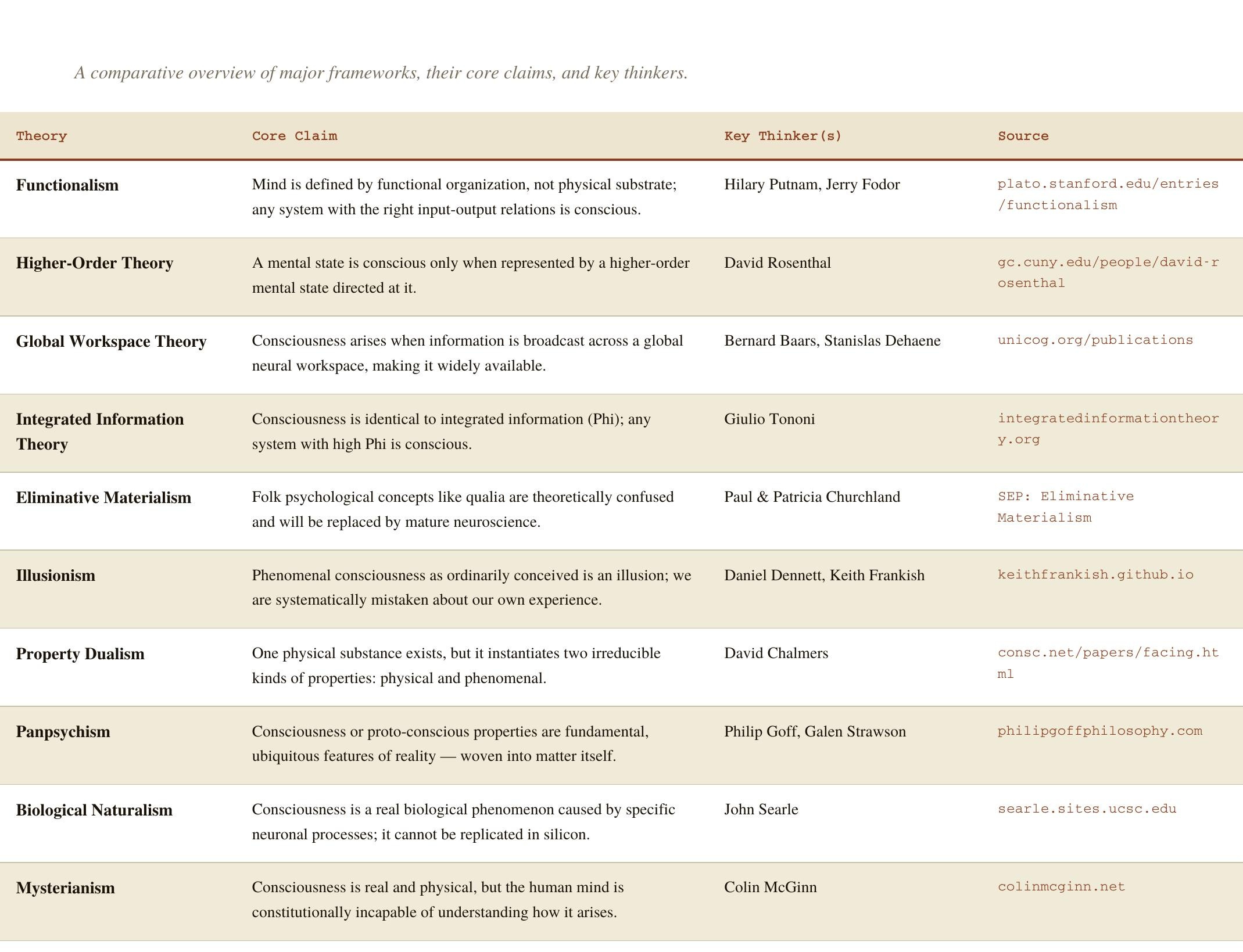
A gift for the journey friends: please find all theories neatly mapped in the table below, you earned it!
Be well,
Matt

Interesting, indeed. I suppose if one subscribes to the idea that consciousness exists universally and beyond, then it does not depend on the brain, nor the make-up of the brain. Perhaps consciousness can, if it chooses, work with silicone as well as all creation?