

Optimize your stress?
No snake oils, just self-honesty

The classic idea “what doesn’t kill you makes you stronger” is appealing for a reason.
It turns suffering into something useful. It gives adversity meaning. It suggests that whatever we go through, as long as we survive it, we come out better on the other side.
But I’m not sure that’s true.
Or at least, not in the way we tend to believe it.
Because if you look closely, most forms of stress don’t make us stronger. They wear us down. Chronic stress, in particular, is associated with almost every negative outcome you can think of—burnout, anxiety, disease, cognitive decline. These aren’t signs of growth. They’re signs of damage.
So the idea that stress is inherently beneficial starts to fall apart.
What science suggests instead is something much more constrained. Stress can be beneficial, but only within a very narrow range. Outside of that range, it stops helping and starts harming. Which means that most of the stress we experience in modern life—psychological, persistent, unbounded—isn’t the kind that leads to growth at all.
It’s the kind that accumulates.
And this creates a strange contradiction.
We celebrate adversity in theory, but in practice, most of the adversity we experience isn’t structured in a way that helps us. It’s not deliberate, not contained, not recoverable. It doesn’t resemble the controlled stress of exercise or fasting. It resembles something closer to overload.
Which might explain why so many people feel stuck, even as they push themselves harder.
They’re not in the hormetic zone.
They’re outside of it.
The hormetic window is narrow. But it’s real.
And once you know what you’re looking for, it becomes impossible to miss it.
The clearest example is exercise. A workout is controlled damage. You push muscle tissue past its capacity, and the body responds by rebuilding stronger. But that only works within a range. Too little effort and you don’t signal the body to adapt. Too much and the tissue can’t recover. The zone where growth happens sits between those two poles — and hitting it consistently requires attention, not just effort.
Fasting works the same way. A short period without food triggers cellular repair, metabolic adaptation, a kind of reset. Extend it too long in the wrong conditions and it becomes something else entirely.
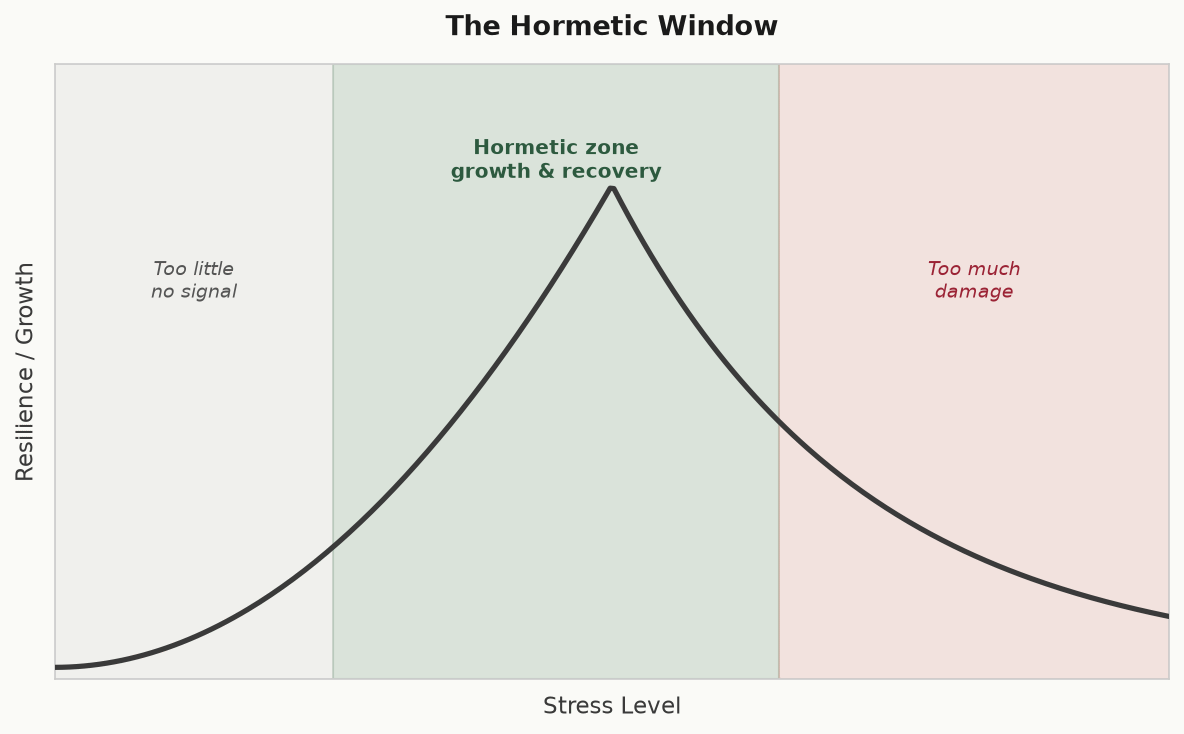
The curve above is hormesis visualized. It’s the scientific term for the phenomenon where a small dose of something harmful becomes beneficial. The dose makes the poison — and the growth.
The shape matters. You can see it plainly: too little stress and nothing happens. The right amount and you adapt, strengthen, deepen. Too much and the curve turns. It isn’t a plateau. It actively declines.
Most of the stress we carry in modern life — the low-grade, persistent, unbounded kind — lives on the right side of that curve.
So how do you begin to tell the difference?
The honest answer is that not all stress announces itself clearly. But there are patterns.
Stress that tends to build:
Physical challenge — exercise, cold, heat, intermittent fasting
Learning something that sits just at the edge of your current capacity
Difficult but honest conversations where both people want to understand
Voluntary discomfort — travel, solitude, starting something unfamiliar
Grief that has space around it
Stress that tends to erode:
Chronic relational conflict, especially where safety is absent
Jobs or environments that ask everything and return nothing in the way of meaning
Prolonged isolation without support
Emotional unpredictability — when you never know where you stand
Situations where agency has been removed completely
The line between them isn’t severity. It’s whether you have the conditions to recover.
This is why people have sometimes chosen the monastery.
Monastic life looks, from the outside, like retreat. But it’s actually a form of engineering. You remove the stressors that overwhelm and introduce ones that build — silence, structure, physical work, community without competition. You lift with less weight, at first. Not because you’re weak, but because the load you were carrying before was too much for adaptation. It was just weight.
Not everyone has that choice.
Some people can’t engineer their conditions. The difficult family is already there. The financial pressure isn’t moveable. The circumstances that need changing require time that hasn’t arrived yet. These people are, in some sense, training with extra weight — and sometimes, people who’ve carried that for long enough do come out on the other side with something the monastery never produced.
But that’s not a prescription, and it’s not guaranteed.
The people who grow from hard circumstances are usually the ones who found some way to interpret what was happening to them. Some sense of agency inside the hardship. Some person or practice that created recovery in the middle of the difficulty. The weight didn’t build them. Their relationship to the weight built them.
What Nietzsche got right is the orientation. The refusal to be passive in the face of suffering. The insistence that something in the difficulty can be turned toward.
What science adds is constraint.
Because some things do kill you. And some things that don’t kill you leave damage that takes years to name, let alone repair. Chronic stress doesn’t make you stronger. It wears down the body’s ability to regulate itself, narrows the capacity for trust, accumulates in ways that compound quietly until one day they don’t.
What makes you stronger is stress you can process. That’s the piece the aphorism leaves out.
So where does that leave you?
Start with an honest accounting — not to judge yourself, but to name what’s actually there.
Some of what you’re carrying you may be able to change: the environment that’s been quietly wearing you down, the relationship with no floor, the work that asks everything and offers nothing back.
Some of it you may not be able to change yet.
Either way, the question is the same: do you have the conditions to recover?
If yes — lean into the hard things. Do the difficult workout. Have the uncomfortable conversation. Start the thing you’ve been avoiding. The friction is the good stuff.
If no — the first work is the conditions. The monastery isn’t weakness. It’s discernment.
What doesn’t kill us can make us stronger. But only when we’re honest about what kind of weight we’re actually holding, and whether we’ve given ourselves any chance to set it down.
Be well.